
The Invisible Engine: Why Clean Content Data Powers the Content OS

(This is part 3 in a series 3 posts. If you missed Part 1, start here: The Ethics of Intelligent Content)
What if your next blog post, chatbot prompt, or product headline wasn’t just a creative asset—but a structured node quietly powering your entire content ecosystem?
We’ve reached a point where content isn’t just copy or creative anymore. It’s infrastructure. Whether your system can amplify that potential—or lets it fizzle into chaos—comes down to one often-invisible layer: the content data layer.
This is the hidden scaffolding of your Content OS. The connective tissue where narrative meets structure. Where creativity becomes componentized. And where the promise of personalization, automation, and AI enablement either scales—or stalls.

Why This Conversation Is Urgent
AI is already threaded through our workflows—writing drafts, suggesting subject lines, triggering dynamic messages. But here’s the thing: AI is only as effective as the structure that feeds it. Without clean, intelligent content data underneath, even the best tools churn out noise.
You might have a shiny CMS or a killer design system—but if your content isn’t structured, governed, and ready to flow across platforms, you’ve essentially built a luxury vehicle with no engine. In a world where velocity matters, structure is what makes speed sustainable. Otherwise, you’re just spinning your wheels.
We’ve All Been There
You’ve likely experienced the friction. A chatbot gives a wrong answer. A teammate recreates something that already exists—because no one could find the original. Your AI tool generates off-brand nonsense because it’s been trained on a mess of outdated content. These are breakdowns in infrastructure.
More specifically: broken metadata, inconsistent taxonomy, content that isn’t modular or reusable. I’ve said it before (and will keep saying it) and anyone who has worked with me knows that I’ll beat my data drum on this as long as its necessary: it’s not about bad content. It’s about bad infrastructure.
From Assets to Systems
The problem? We’re still trained to treat content like a final deliverable—a single-use output that lives in one channel and dies there. But in today’s ecosystem, content is a living asset. It evolves, circulates, reconfigures.
A blog headline might become a push notification. A product description might seed chatbot responses. A CTA might be pulled into a paid ad. But this kind of channel fluidity doesn’t happen by accident. It requires content to be structured, labeled, and designed for modularity from the start—and it requires a system that knows how to carry it across touchpoints.
Without that system—the connective framework that moves content across channels in context—you end up with beautiful fragments stranded in silos.
Let’s Talk About the Framework
Clean data is just part of the equation. You also need a transport system—the APIs, headless CMSs, integration hooks, content modeling, governance layers, and platform interconnections that allow content to move where it needs to go, when it needs to get there.
Modular content can’t deliver value unless the infrastructure is built to support modular delivery. That means:
A content model that defines how content components relate and recombine
A governance layer that enforces naming, tagging, and usage guidelines
Delivery systems (like headless CMS or orchestration layers) that allow content to flow across web, app, chatbot, email, and emerging interfaces
This is the difference between a beautiful library and an intelligent ecosystem. One stores. The other adapts and responds
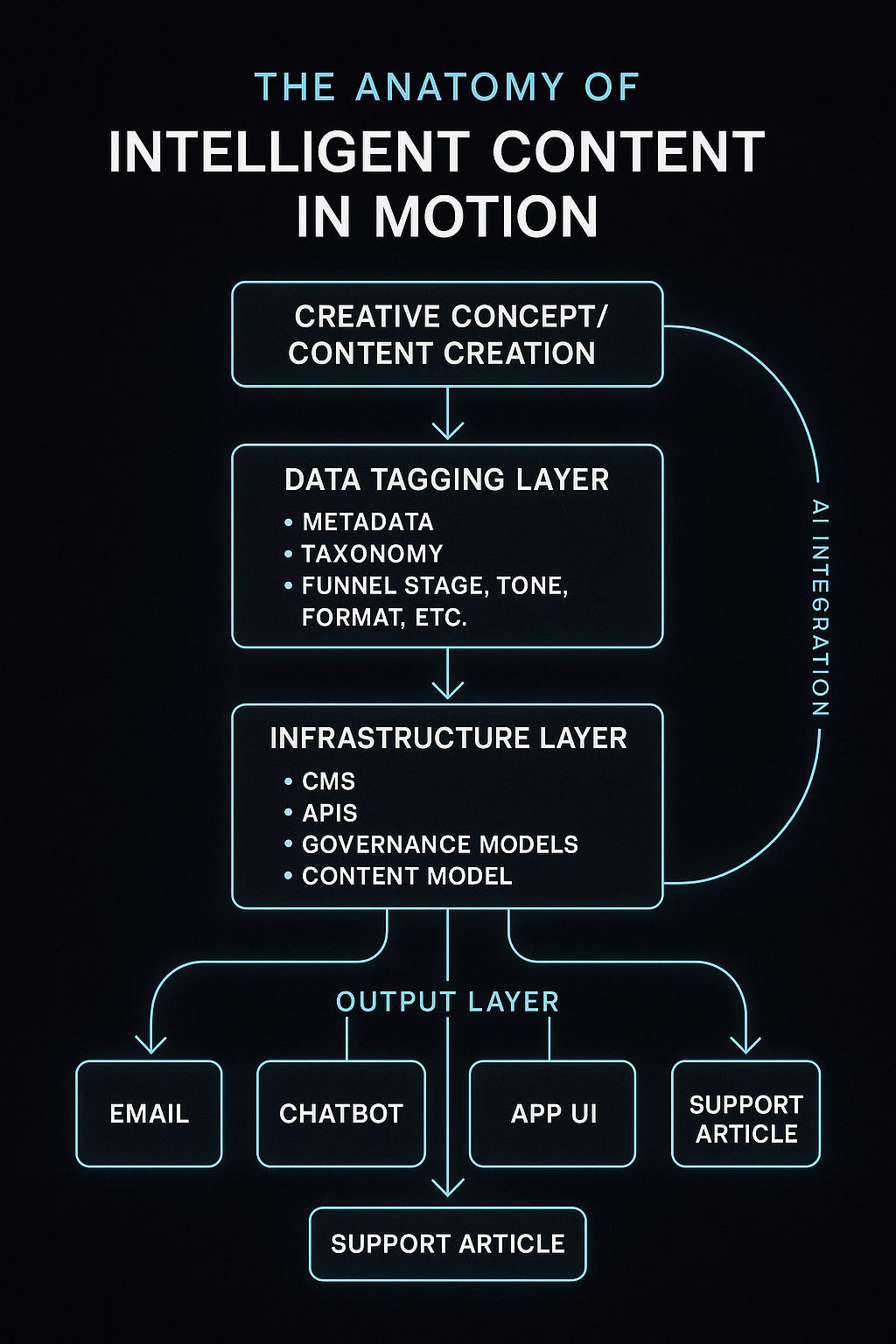
Alt Text: Infographic titled "The Anatomy of Intelligent Content in Motion" showing content flow from creation through tagging, infrastructure, and output channels (email, chatbot, app UI), with an AI integration loop around the system. Neon blue on black background.
What Does Clean Content Data Actually Enable?
Let’s walk it out. A UX writer creates a CTA for a landing page. But because it’s built modularly—with structured metadata for purpose, funnel stage, format, and tone—it doesn’t just live in that one page. It travels.
That same CTA becomes part of:
A targeted email in an onboarding series
A contextual chatbot reply within an app
A headline in an A/B-tested paid campaign
A voice command in a future voice UI
This is how content becomes an intelligent asset. Structured to move. Governed to perform. And yes—designed to support AI tools and personalization at scale.
Creatives as System Thinkers
No, your writers don’t need to become metadata architects. But they do need to think like system builders. Ask:
Can this be reused?
Is it labeled for findability?
Will someone (or some AI) understand what this is and how to use it?
Are we building content for a moment—or for a system?
When creatives design with these questions in mind, they build content that doesn’t just ship. It scales. And, most importantly, it enables consistent, human-centered content experiences.
Creativity flourishes within effective systems. When you design your content with structure and purpose, you create stories that are not only beautiful—but also durable, scalable, and strategically powerful.
What Success Looks Like
Success isn’t always flashy. Some of the best content systems I’ve seen are quiet in appearance but powerful in performance—functional, efficient, and built to scale. Success means having a modular content library that updates across products in real time; AI assistants that speak fluently in your brand voice because they’re trained on structured, consistent components; support content that adapts dynamically to evolving user needs across every channel; and content teams that collaborate seamlessly instead of duplicating work. But none of that is possible without the right framework. Without infrastructure to carry content across the experience layer, modularity remains a concept, not a capability.
Final Thoughts: Content That Moves
We’re entering a new content era—one where your audience expects tailored, trustworthy, real-time experiences, and where your AI systems can only deliver if the data beneath them is strong. Content isn’t just something you publish; it’s something that needs to move—fluidly and intelligently—across screens, interfaces, moments, and modes of interaction. Clean data is the fuel. Modularity is the design. Infrastructure is the engine. When these elements work in harmony, your content doesn’t just travel—it performs. If you build that system now, you won’t just keep pace with change. You’ll be positioned to lead it.
And one final note: treat your content technologists—your metadata specialists, taxonomists, and content modelers—not as back-office support, but as strategic partners. They’re not just behind the scenes. They’re building the infrastructure your future depends on.
Works Cited
Gartner: How to Produce Modular Content to Drive Personalization at Scale
“How to produce modular content to drive personalization at scale,” MarTech
#IntelligentContent #ContentData #ContentOS #ModularContent #MetadataMatters #AIContent #TaxonomyStrategy #FutureOfContent #Infrastructure